
From Marathoner to Triathlete: My First Ironman 70.3 in Muskoka


As an endurance athlete, the marathon is a discipline that always commands respect. No matter how many you run, every race comes with its own surprises.
But this time, I wanted something different.
Something inside me started craving a new endurance challenge, something bigger.
And that’s when I found it.
The Ironman 70.3.
While I’m a decent swimmer who competed as a kid, I left the pool for many years. Now, at 41, I wanted to try something new.
It was March, shortly after completing the Cincinnati Marathon, when the idea started forming. Coming off another marathon finish, I felt that familiar endurance high, but also a curiosity for a new challenge.
That’s when I decided to register for the Ironman 70.3 Muskoka, even though I didn’t fully understand everything the sport involved.
Wetsuit?TT bike?, Bike trainer?, Pull buoy?, Bike computer?, Triathlon clothing?
And that was just the beginning.
At first it sounded exciting, exploring three sports at once. Not so exciting for the wallet, though. With a $500+ CAD registration fee, plus gear for swimming, biking, and running, the big question quickly became:
Is it worth it?
Let’s find out.
The Pool Training
March began with my first swim sessions.
My starting point: 1,200 meters with a rusty technique.
I had to recover the muscle memory from childhood, rebuilding confidence in the water stroke by stroke.
After about a month, I completed my first 1,500-meter swim at a 2:20 pace per 100 meters, and the best part was finishing without feeling like I was going to faint.
It felt great.
Then came the next milestone.
The following month I completed 1,900 meters, the official Ironman 70.3 swim distance.
That day felt like a huge victory in my training journey.
The Bike Training

There was just one problem.
I didn’t own a bike.
Marketplace quickly became my best option. I wasn’t ready to invest thousands of dollars without knowing if I would fall in love with the sport.
That’s when I found it.
A Cervélo P2K from the early 2000s, sold by a kind retired woman.
The bike needed some work. I tuned it up, installed clip-in pedals, bought cycling shoes, added a small tool compartment, and installed a water reservoir between the aerobars.
Everything was new to me, and honestly, that made it even more exciting.
April began with my first outdoor rides.
But before riding on pavement, I went straight to a grassy park to practice clipping in and out of the pedals. I had practiced on my bike trainer before, but doing it outside felt very different.
Two small falls later, all within the first hour I finally felt confident enough to ride.
From that point on, I trained consistently, building from 30 km rides to a maximum of 80 km before race day.
The Running Training
Running was my strongest discipline.
With multiple marathons behind me, I felt confident going into this part.
But triathlon running is different.
I had to learn how to run with tired legs after swimming and cycling, and that’s not easy.
Training also meant getting used to running in a tri-suit, figuring out nutrition, and learning how to avoid chafing during long sessions.
My longest brick session before race day combined all three sports and included a 15 km run.
A Team Effort

This wasn’t a solo journey.
Luckily, I have two triathlete friends who encouraged me to sign up and helped guide me through the training process.
Huge thanks to them, they also came with me to Muskoka to support me on race day.
Having experienced athletes around makes a huge difference.
Bib Pickup Day

Unlike marathons, triathlon events include both bib pickup and bike check-in.
We left Toronto early Saturday morning, attaching my bike to a Thule rack on the car, a brand highly recommended by cyclists.
Our first stop near Muskoka was Costco.
The drive was relaxed, chatting with friends while loading up on pizza and pasta for carb loading.
At the event site, I picked up my race kit, grabbed some Ironman merchandise, and placed my bike in the assigned rack inside the transition area.
Before leaving, I slightly deflated the tires to avoid pressure issues overnight.
Then came one of the best moments of the day.
We jumped into the lake for a quick practice swim before sunset.
After that, we checked into the hotel and celebrated the evening with something unexpected: a massive Kawartha Dairy ice cream.
Before heading back, we made a quick stop for last-minute supplies: Gatorade, Red Bull, and a couple of beers for my friends.
Race day was coming.
Race Morning
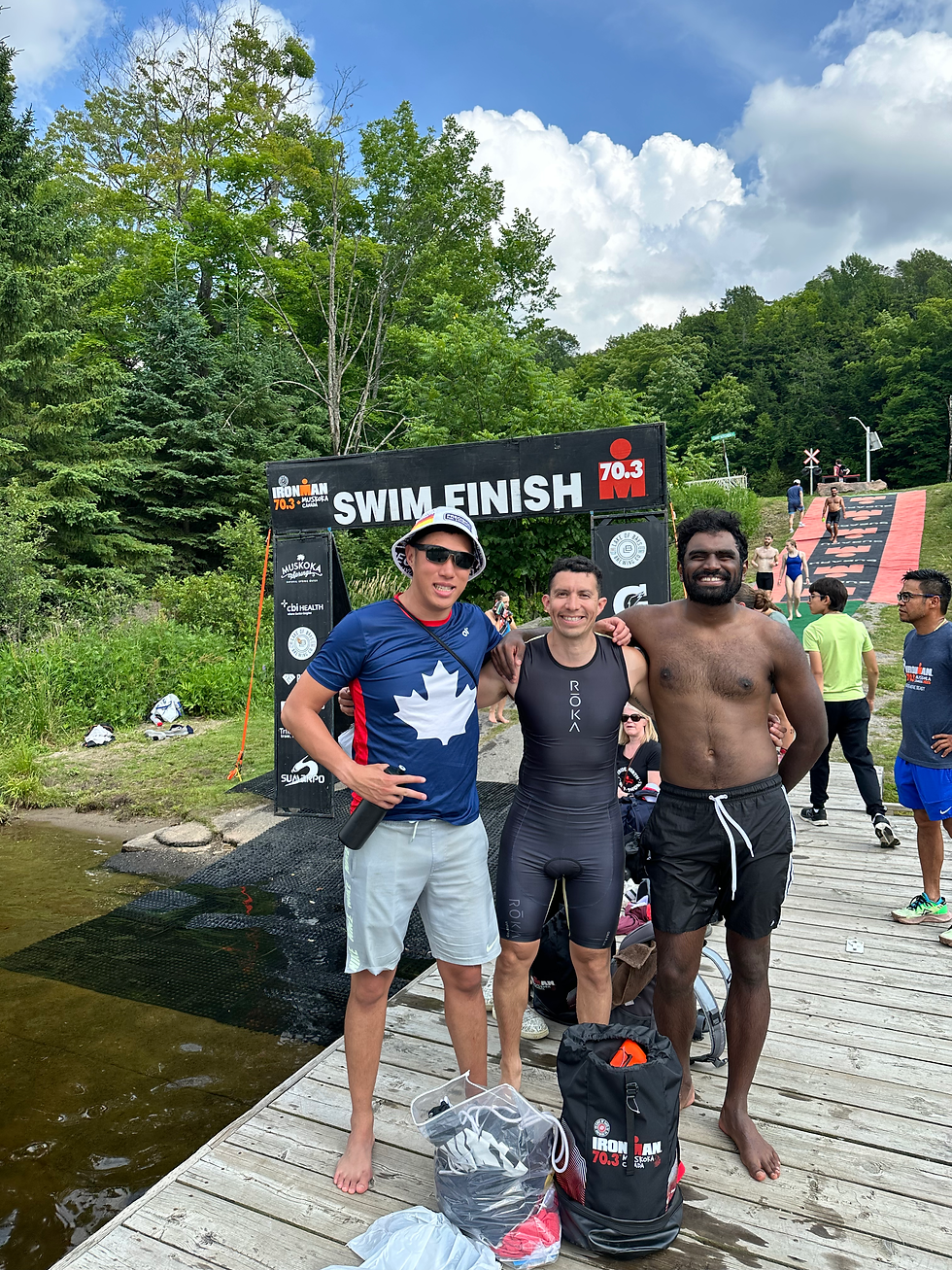
Sleep didn’t go as planned.
Between excitement and nerves, I managed about three hours of sleep.
Still, when the alarm rang, adrenaline kicked in.
Bananas ready. Electrolytes ready. Rea Bull ready. Nutrition Bars ready.
All my gear packed inside the Ironman backpack from the registration kit, which even includes a compartment for wet clothes.
When I arrived at the bike racks and began setting up my transition area, the atmosphere was surreal.
Some athletes had incredibly advanced bikes and equipment.
Others looked like me — simply trying to accomplish a major life goal.
Then it was time to say goodbye to my friends, hand them my phone and camera, and head toward the lake.
The Swim

Standing at the swim start, my heart was racing.
The energy from the crowd was incredible, families cheering, athletes encouraging each other.
Then the horn sounded.
Hundreds of swimmers entered the water at once, each trying to find space and rhythm.
I reminded myself to trust my pace, the same strategy I practiced in training.
The water temperature was comfortable, so I used ROKA buoyancy shorts instead of a wetsuit, which made the transition easier.
After 45 minutes, I completed the 1.9 km swim.
My friends were waiting near the transition area to give me a high-five, exactly the boost I needed.
Transition One
Running barefoot toward the bike racks was a moment of tension.
I was worried about stepping on something sharp that could end my race.
As I sat down to put on my cycling gear, I felt a small cramp in my calf.
A quick shot of pickle juice solved that immediately.
I was ready.
The Bike

Helmet on. Glasses on. Gels ready.
Time to ride.
At kilometer 40, my hamstrings began tightening and a small cramp appeared.
But focusing on my pace helped me push through.
My Cervélo P2K, with its older 650c wheels (smaller than the modern 700c standard used on most bikes today), required noticeably more pedaling compared with the larger wheels around me.
But sometimes heart matters more than technology.
Eventually I completed the 90 km bike segment in 3:44:08.
Transition Two
This transition felt much faster.
Helmet off.Cycling shoes off.
Then I slipped on my Nike Alphafly 3.
Time to run.
The Run

The cramps returned.
Stronger than before.
And right at the beginning of the run course there’s a serious uphill section.
At that moment I thought:
Why did I sign up for this suffering?
Another pickle juice shot helped again.
Then something unexpected happened.
A good friend of mine who owns a cottage in Muskoka surprised me by biking over to the race course and taking a quick selfie with me.
That moment gave me a huge boost.
Now it was just me versus my mind.
My typical half marathon time is around 1:47, and my Garmin predicted somewhere between 1:50 and 1:55.
But the hills had other plans.
They were brutal.
Still, the support from spectators along the course kept pushing me forward.
And after 2:06:39, with destroyed legs but a huge smile on my face, I crossed the finish line.
At that moment, I said it out loud:
I’m a triathlete.
Race Stats — Ironman 70.3 Muskoka
Swim (1.9 km) - 45:19
Transition 1 - 09:33
Bike (90 km) - 3:44:08
Transition 2 - 04:51
Run (21.1 km) - 2:06:39
Finish Time. 6:50:31
Gear Used on Race Day
Bike: Cervélo P2K (650c wheels)
Cycling Shoes: Adidas cycling shoes
Helmet: Louis Garneau helmet
Cycling Glasses: Van Rysel cycling glasses
Tri Suit: Wattie Ink triathlon suit
Running Shoes: Nike Alphafly 3
Hydration System: Nathan hydration belt
Nutrition: Precision Hydration gels
Swim Gear: ROKA buoyancy shorts
Training Tools
ROUVY cycling trainer app
Wahoo speed and cadence sensor
Nike water bottles

Comentarios